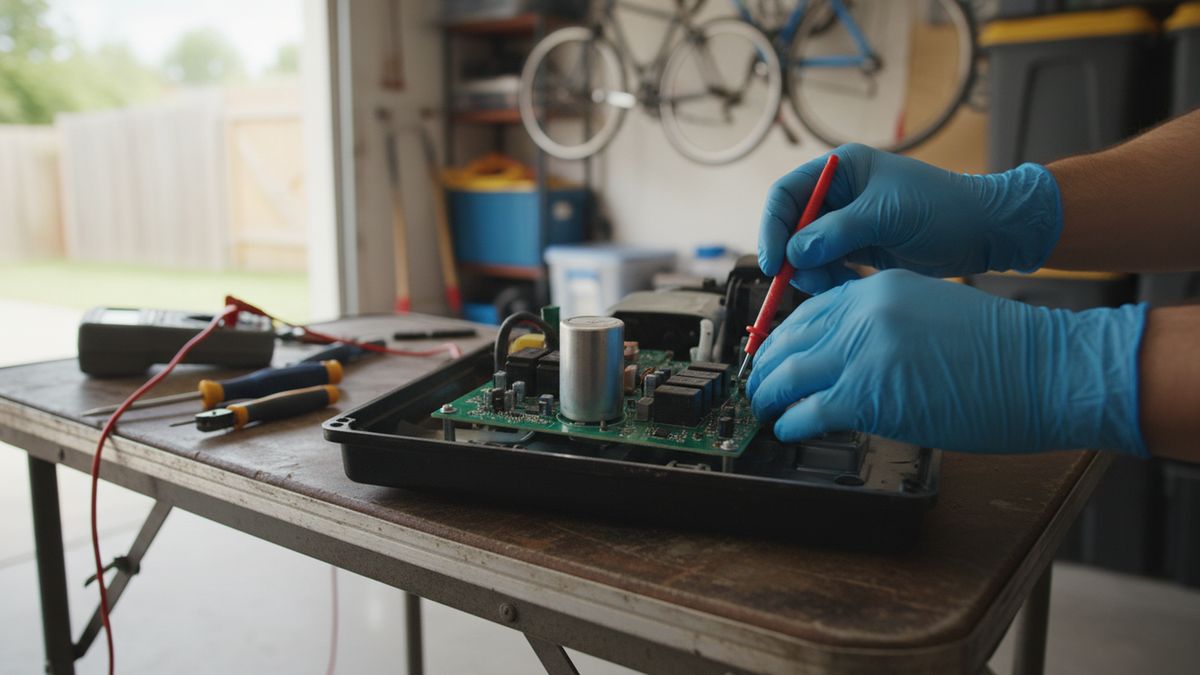
What Does the Logic Board Do in a Garage Door Opener?
The logic board is the opener's brain, one circuit board that receives the signal from your remotes and keypad, reads the wall button, watches the 2 photo eyes, counts the motor's travel, applies the force limits and switches the motor and light. Every function you touch passes through it, so a failing board produces a strange mix of symptoms.
On most residential units the board sits inside the motor housing directly behind the light cover, with the radio receiver, the terminal strip for the wall button and sensors, and the learn button all mounted on it. Some boards also carry the Wi-Fi radio on newer Chamberlain, LiftMaster and Genie units. The travel and force adjustments live there too, either as dials on older openers or as button-programmed values on current ones.
Because so much runs through one board, a fault can look like a remote problem, a sensor problem or a motor problem before it reveals itself as a board problem. Working out which is what a service call is for.
Symptoms of a Failing Logic Board
Boards rarely die all at once. They misbehave for weeks or months first, usually when the garage is hottest. These are the 8 patterns we see most often, roughly in order of how strongly they point at the board rather than something cheaper.
| What happens | Most likely cause | Board suspect? |
|---|---|---|
| Wall button works, every remote and the keypad do not | Radio receiver section of the board has failed | Strong |
| Door opens or closes on its own | Board fault, occasionally a shorted wall button wire | Strong |
| Opener forgets travel limits or remotes after a power blip | Board memory failing | Strong |
| Nothing at all, light off, outlet is live | Board, or a blown transformer feeding it | Strong |
| Works in the morning, refuses on hot afternoons | Heat-stressed board or capacitor | Moderate |
| Motor hums, door does not move | Stripped drive gear or failing capacitor | Weak |
| Door starts down and reverses, light flashes | Photo eyes blocked or misaligned | Weak |
| Remote range has shrunk to a few feet | LED bulb interference, remote battery, or a weak receiver | Moderate |
The bottom three rows matter because they are cheaper problems that get misdiagnosed as a board. A stripped gear kit or a swollen capacitor is a straightforward repair, and a sensor that has been kicked out of line costs nothing but a minute. We check all of those before we condemn a board. For a dark or flickering sensor light, Chamberlain's troubleshooting guide is worth five minutes before anyone blames the board.
Why Frisco Garages Kill Logic Boards
Heat is the main cause. An uninsulated, west-facing garage can sit at 130 to 150 degrees at the ceiling on a summer afternoon, and the board lives at the ceiling, inside a plastic housing, next to a light bulb. Electrolytic capacitors dry out faster at those temperatures, solder joints fatigue, and the board ages several times faster than the same part up north.
Power surges are the second cause and the more sudden one. North Texas spring thunderstorms bring lightning, and a strike anywhere on the neighborhood grid sends a spike down the line. The opener is plugged into an unprotected ceiling outlet on almost every house we visit, and a surge that a computer on a protected strip shrugs off can end a board instantly. A dead opener after a storm is a board until proven otherwise. The NWS forecast office serving Collin County issues the severe thunderstorm warnings for Frisco, and unplugging the opener while one is out costs nothing.
Age finishes what heat and surges start. Most openers on Frisco houses built in the 2000s are now well past ten years old, and a board that has cooked through a dozen summers has little margin left. The newest streets out by the PGA of America campus at Fields Ranch are the exception, with openers young enough to still be under the maker's warranty, so check the label date before paying for anything.
Moisture and insects round out the list. Wasps and spiders nest inside the housing, and a nest across the board can short it. That one is cheap to fix if it is caught early.

What a Logic Board Replacement Involves
Replacing a board takes about an hour. The technician cuts power, removes the light cover and housing, photographs the wiring, unplugs the sensor and wall-button leads from the terminal strip, swaps the board, and reconnects everything. The new board then needs its travel limits and force settings programmed, every remote and keypad re-learned, and the photo eyes and auto-reverse tested against a 2x4 laid flat on the floor.
The part has to match the opener. Boards are specific to model families and often to production years, and the wrong one will not fit the housing or drive the motor correctly. The model label under the light cover has the number we need, and our opener repair service in Frisco carries the common LiftMaster, Chamberlain and Genie boards on the van.
The board sits beside the transformer and a motor capacitor that can hold a charge after unplugging. Swapping a board is not dangerous for someone who does it weekly, but it is a poor first electrical project. If the symptoms above match, unplug the opener and call.
New Board or New Opener? The Decision
A board replacement runs $145 to $325 installed, depending on the model. A new belt-drive opener with Wi-Fi and battery backup runs $395 to $700 installed. With those numbers, the age of the opener decides it: under 12 years, fix the board; past 12, or with a second fault alongside it, put the money toward the new unit.
| Opener age and condition | Our usual advice | Why |
|---|---|---|
| Under 8 years, otherwise sound | Replace the board | Years of life left, parts readily available, cheapest fix by far |
| 8 to 12 years, gear and motor fine | Replace the board, budget for the opener | Still worth repairing, but the next failure is not far off |
| Over 12 years, or board plus another fault | Replace the opener | A board plus a gear kit approaches half the price of a new unit |
| Any age, board no longer made | Replace the opener | Salvaged boards are a gamble with no warranty |
| Made before 1993, no photo eyes | Replace the opener | Predates the UL 325 entrapment protection requirement |
| Chain drive under a bedroom | Consider replacing with a belt or wall-mount | The failure is a chance to fix the noise too |
If you land on replacement, our comparison of belt, chain and wall-mount openers walks through the choice by bay. And since the Wi-Fi radio lives on the board in most new units, our guide to myQ openers that will not connect is worth a read before you decide a brand-new opener has a bad board. Nine times out of ten that one is the router.
Protecting the New Board
Two cheap habits roughly double the life of a board in a Frisco garage. Plug the opener into a surge protector rated for motor loads, mounted at the ceiling outlet, and replace it after any big storm season. And use only the bulb type and wattage the opener lists, since an oversized incandescent bulb adds heat to the housing and some LED bulbs interfere with the radio receiver.
Beyond that, keep the door balanced and the rollers moving freely so the motor and board are not working against friction. The balance test, the sensor check and the monthly reversal test are all in our seasonal maintenance schedule for North Texas garage doors, and they take ten minutes a season.
When the opener does finally quit, it tends to quit at seven in the morning with the car inside. Pull the red release cord only with the door fully closed, lift it by hand if the springs are intact, and treat a trapped car as the emergency call it is. Otherwise phone Marlowe Garage Door Service in Frisco. A board or a new opener is normally fitted the same day.
Logic Board Questions From Frisco Homeowners
How do I know if my garage door opener logic board is bad?
The clearest sign is remotes and the keypad all failing at once while the wired wall button still works, since the radio receiver is on the board. A door that opens by itself, an opener that forgets its limits after a power cut, or a unit that is completely dead with power at the outlet also point to the board. Humming without movement usually points to the gear instead.
How much does it cost to replace a garage door opener logic board?
In Frisco, $145 to $325 installed in 2026, depending on the opener model and whether the board is a current part. That includes reprogramming the travel limits, force settings and every remote. If the opener is more than about twelve years old, a new belt-drive unit at $395 to $700 is usually the better use of the money.
Can a power surge damage a garage door opener?
Yes, and it is one of the two most common ways a logic board dies here. Lightning during a North Texas spring storm sends a spike through the grid, and the opener is nearly always on an unprotected ceiling outlet. A surge protector rated for motor loads at that outlet is cheap insurance.
Why does my garage door opener only fail on hot afternoons?
Heat-stressed components on the board, or a tired capacitor, work when cool and fail when the garage ceiling reaches 130 degrees or more. It is an early warning that the board is on its way out. Have it looked at before it fails completely, ideally before the next summer.