How Often Should a Garage Door Be Serviced?
A residential door needs a safety test every month, a lubrication and balance check every six months, and a professional tune-up once a year. That is about 10 minutes a month from you and one visit from us. Doors that get that attention run 20 to 30 years.
North Texas doors need a schedule rather than an occasional look because the weather here runs in hard seasons. Spring brings hail, summer bakes the grease out of everything, and winter delivers a few freezes that find every stiff hinge. Timing the checks to those seasons catches problems before the weather does.
The North Texas Garage Door Calendar
Here is the schedule we give Frisco customers, 7 rows covering the whole year. The monthly items repeat every month; the seasonal items are timed to what the weather is about to do, so the door is ready before hail, heat or a freeze arrives rather than after.
| When | What to do | Why now | DIY or pro |
|---|---|---|---|
| Every month | Reversal test with a 2x4, photo eye wave test, listen for new noises | Safety features drift and fail quietly | DIY |
| Late February | Lubricate hinges, rollers, springs and bearings; tighten hardware; check weather seals | Ahead of hail season and spring storms | DIY |
| March to June | After any hail, inspect sections for dents and check the door still runs true | Peak North Texas hail season | DIY, pro if panels are dented |
| May | Balance test; check the opener force and travel; fit a surge protector at the opener outlet | Before the heat and the summer storm surges | DIY test, pro adjustment |
| July to August | Watch for an opener that struggles on hot afternoons; keep the track clean | Garage ceilings run 130 degrees and up | DIY watch, pro if it hesitates |
| October | Second lubrication; replace the bottom seal if cracked; check cables for fraying by eye | Before the first freeze, typically mid to late November | DIY, pro for cables |
| Once a year | Professional 25-point tune-up: spring tension, cable and drum condition, roller wear, opener settings | Catches the things a homeowner should not touch | Pro |
DFW averages about 20 days a year at or above 100 degrees, and most of them fall between late June and early September. That is the stretch when a marginal opener or a dry spring finally gives up, which is why the May items sit where they do.
The Monthly Ten-Minute Safety Check
Two tests, both built into the safety standard every opener sold since 1993 has had to meet, and both simple enough to do in under 10 minutes with a scrap of 2x4 and a broom handle. They confirm the door will stop and reverse before it can trap a person or a pet. The standard is 16 CFR Part 1211, and the Consumer Product Safety Commission is the agency behind it.
The reversal test. Lay a 2x4 flat on the floor in the door's path, roughly in the middle. Close the door from the wall button. When the bottom edge touches the board, the door must stop and reverse back to open. If it stalls on the board, pushes against it, or keeps going, the close force is set too high or the opener's reversing circuit has failed. Stop using the opener until it is adjusted.
The photo eye test. Start the door closing, then wave a broom handle through the beam between the two sensors near the floor. The door should reverse immediately. The sensors must sit within 6 inches of the floor, face each other squarely, and have clean lenses. If a sensor light is flickering or off, gently nudge the bracket until it steadies.
While you are there, listen to one full cycle. A new scrape, squeak or bang is the earliest warning you will get about a roller, hinge or spring, and it is far cheaper to hear it in March than to have it fail in August.

Lubrication Every Six Months, Done Correctly
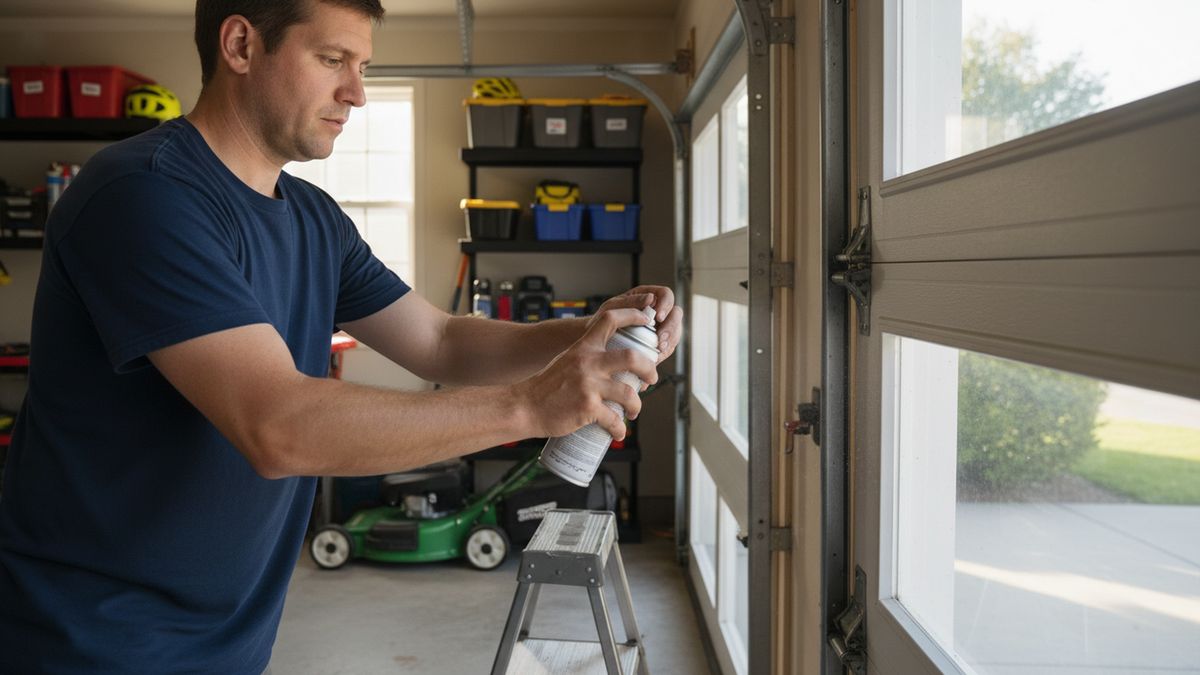
Lubrication is the most useful thing a homeowner can do for a door, and the one most often done wrong. Buy a white lithium grease or a garage-door silicone spray, not a general-purpose oil. Do not use WD-40 as the lubricant; the standard product is a solvent and water displacer that dissolves the grease that is already there and leaves the metal dry within weeks. The WD-40 brand does sell a separate white lithium grease that is fine. DASMA's technical sheet on spring life backs this up, naming regular lubrication as one of the ways to get a spring to its full rating.
Apply it to the moving metal parts: the hinge pins, the roller stems and bearings on steel rollers, the torsion springs along their length, the end bearing plates and the center bearing, and the opener's chain or the trolley rail.
Do not lubricate the track. Rollers are meant to roll along a clean track, not slide on a greasy one, and grease there collects grit. A dry rag run down the inside of each track is all it needs.
Lubricating a torsion spring is safe. Adjusting one is not. The spring and the cables attached to the drums carry the full weight of the door under tension, and a bottom bracket or set screw loosened by hand can release that tension in an instant. If a cable looks frayed or a spring has a gap in the coil, stop and call.
The Balance Test, Twice a Year
A balanced door is what keeps the opener alive, so check it every spring and fall. Close the door completely, then pull the red release cord so the opener lets go of the trolley. Raise the door by hand to roughly waist height and take your hands away. A balanced door stays where you left it, or drifts an inch or two. A door that drops has springs that have lost tension. A door that shoots upward is over-wound.
Either result is a professional adjustment, because it means winding or unwinding the torsion spring with bars. Do not compensate by turning up the opener force, which only makes the reversal test fail. Our spring adjustment and replacement service handles both, and while the technician is there the drums and cables get a look. Frayed strands at the bottom of a cable are common on doors past ten years, and a cable replacement at a tune-up is a fraction of the cost of one after it snaps.
Re-engage the opener by pulling the release cord back toward the door until the trolley clicks, or run the opener once and let it pick the carriage up.
Season-Specific Notes for Frisco Doors
Before hail season. Make sure the door runs freely and the reinforcement struts across the inside of a wide door are tight. A door that is already binding takes hail worse, because a dented section on a stiff door is more likely to crack at the stile. After a storm, look for dents and check that the door still closes flat. NOAA's Storm Prediction Center keeps the daily hail reports if you ever need to date a storm for an insurer.
Summer. Heat thins lithium grease and cooks opener boards. If the opener hesitates on hot afternoons but runs fine in the morning, that is the board asking for help before it fails outright, a pattern we cover in our guide to logic board failure in Texas garages. A surge protector at the ceiling outlet is the cheapest insurance you can buy before the summer storm season.
Before the first freeze. Grease stiffens and steel loses a little forgiveness in the cold, which is why springs so often break on the first frosty morning of the year. The October lubrication, a fresh bottom seal so the door does not freeze to the slab, and a balance test give the door its best chance. If the seal freezes to the slab, free it by hand before running the opener.
All year. Watch the gaps. Daylight at one bottom corner, or a door that rubs the jamb on one side, usually means the opening has moved with the soil under the slab. That is a track and jamb adjustment, not a door problem, and catching it early stops the rollers wearing unevenly.
What Belongs in the Annual Professional Tune-Up
The yearly visit covers what needs tools, training or a second person. Spring tension is measured and corrected. Cables and drums are inspected for wear and reseated if needed. Rollers, hinges and bottom brackets are checked and worn ones replaced. The opener's travel limits and force are reset to specification, the auto-reverse is tested, and any Wi-Fi and remote issues are sorted. In Frisco that runs $95 to $165 for one or two doors, confirmed before we start.
A tune-up is also where the door's age gets an honest assessment. Our timeline of what fails first on a builder-grade door shows what a technician is looking for at each age, and if the sections are past saving, you will hear it then rather than after paying for parts. Anything else that turns up is a call to Marlowe Garage Door Service in Frisco, seven days a week.
Maintenance Questions From Frisco Homeowners
What is the best lubricant for a garage door?
White lithium grease or a silicone spray sold for garage doors. Apply it to hinge pins, roller bearings, the torsion springs and the bearing plates every six months. Do not use standard WD-40 as a lubricant; it strips the existing grease. Never lubricate the track. Wipe it clean instead.
How do I test my garage door's auto-reverse?
Lay a 2x4 flat on the floor under the middle of the door and close it from the wall button. When the door touches the board it must stop and reverse. Then start it closing again and wave an object through the photo eye beam near the floor; it should reverse at once. Do both tests monthly.
Can I adjust my own garage door springs?
No. Torsion springs are wound under enough tension to cause serious injury, and adjusting them requires winding bars and the correct turn count for the door. Lubricating a spring is fine. If the balance test shows the door dropping or rising on its own, book a professional adjustment.
How much does a garage door tune-up cost in Frisco?
A professional tune-up and 25-point safety inspection runs $95 to $165 in 2026 for one or two doors, confirmed on site before the work starts. It includes spring tension, cable and drum inspection, roller and hinge checks, opener limit and force settings and the auto-reverse test. Worn parts are quoted separately.
When is the best time of year to service a garage door in North Texas?
Late February and October. The first visit gets the door ready for hail season and summer heat; the second gets it ready for the first freeze, which typically arrives mid to late November. If you only do one, make it the fall one, because springs break most often on cold mornings.