What Does Builder Grade Mean on a Garage Door?
Builder grade means the lowest-cost door and opener package that meets code, chosen by the home builder to hit a price per house. On a typical production home that is a 25-gauge non-insulated steel door, 10,000-cycle torsion springs, steel rollers with no ball bearings, a 1/2 HP chain-drive opener and light-duty hinges.
None of that is bad. It is simply sized for the first owner, not the third. A 10,000-cycle spring is rated for ten thousand opens and closes, and a family that uses the garage as the front door burns through 1,500 to 2,000 cycles a year. The math tells you roughly when the first big failure lands.
Frisco has an unusual amount of this stock in one place. Most of the city's houses went up between 1999 and 2015, which means a huge cohort of doors are all between ten and twenty-five years old at the same moment. The streets in Plantation Resort were among the earliest, and many of those doors have already been re-sprung twice.
The Builder-Grade Failure Timeline
Here is the order we see on service calls across Collin County, with the usual age window for each of the 6 stages. Your door may run early or late depending on how many times a day it moves, but the sequence itself rarely changes from one house to the next.
| Age window | What fails | What you notice | Fix and typical range |
|---|---|---|---|
| Years 3 to 6 | Steel rollers, dry hinges, loose lag screws | Grinding, rattling, a shudder at the top of travel | Nylon roller set, $110 to $200; hinge and hardware tune-up, $95 to $165 |
| Years 5 to 8 | Bottom weather seal, opener light socket, keypad battery | Daylight under the door, bugs and dust, dead keypad | Seal and small parts during a tune-up |
| Years 7 to 12 | 10,000-cycle torsion spring | A loud bang, then a door that will not lift | Matched pair replaced, $295 to $525 |
| Years 8 to 12 | Lift cables and drums, worn by a broken spring or rust | Door hangs crooked, cable piled on one drum | Cable pair, $145 to $265 |
| Years 8 to 15 | Opener drive gear, capacitor, photo eyes, logic board | Motor hums but nothing moves, random reversing, remotes drop out | Opener repair, $145 to $325; new belt-drive opener, $395 to $700 |
| Years 15 to 25 | Section rust at the bottom, cracked stiles, dented panels | Rust bleed on the bottom section, panels bowing in the middle | Single section, $325 to $800; new insulated door, $1,350 to $4,800 |
Two things move a door left on that timeline: heat and cycles. A garage that faces west and bakes every afternoon dries the grease faster, and a house with teenagers driving cycles the door twice as often as a retired couple's.
Years 3 to 6: Rollers, Hinges and the First Noises
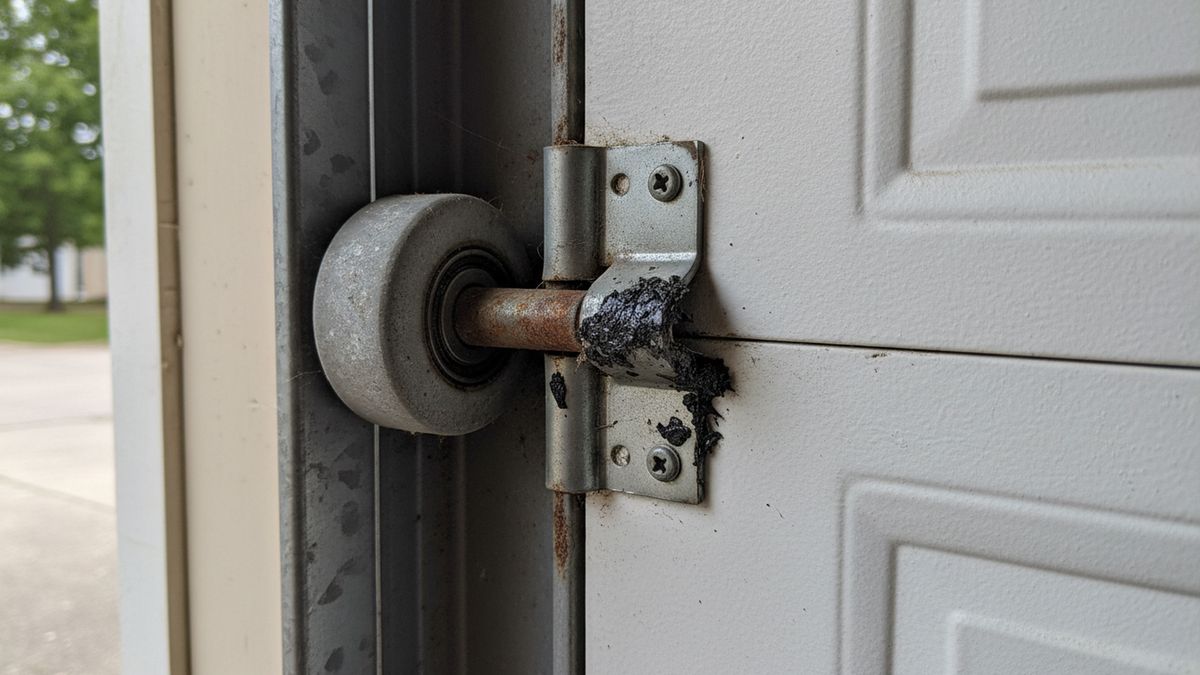
The first thing to wear on a builder-grade door is the roller, usually inside 5 years. Builders fit plain steel rollers with a short stem and no bearings. They start to grind, then flatten on one side, and a flat roller drags through the curve of the track and shakes the whole door.
The hinges follow. Builder hinges are stamped from thin steel, and the number 1 hinges along the bottom carry the most stress. They loosen, the lag screws back out of the section, and the door begins to rattle in the wind. None of this stops the door from working, which is why most people live with the noise for years.
This is the cheapest stage to intervene. A set of 13-ball nylon rollers, tightened hinges and a proper lubrication takes about an hour and makes a ten-year-old door sound new. It also takes strain off the opener, which matters later in the story.

Years 7 to 12: The Spring Breaks
The builder spring is the big one, and it breaks between years seven and twelve on most Frisco doors. A 10,000-cycle spring at four to six cycles a day is used up in five to seven years of calendar time, and the ones that last longer belong to households that use the front door instead. When it goes, the door weighs 150 to 250 pounds again and the opener cannot lift it. DASMA technical data sheet 190 names the reasons that window arrives early: heat, dry coils and a door that got heavier after the spring was chosen.
Everything about the spring is a professional job. It is wound under enough tension to break bones, and setting the turn count wrong leaves the door either too heavy for the opener or floating up on its own. Our torsion spring replacement service in Frisco covers both springs in a pair, because the second one has the same mileage and is weeks behind.
If you heard a bang in the garage and the door now lifts a foot and stops, do not keep pressing the button. The opener will bend the top section or pull a cable off its drum. Leave the door closed, use another exit and call.
The spring failure often takes the cables with it. When the door drops, the drums unwind and the cable jumps its groove, so a cable that has come off the drum is frequently discovered at the same visit.
Years 8 to 15: The Opener Gets Tired
A builder 1/2 HP chain-drive opener that has spent years lifting a door with worn rollers and a tired spring has been working harder than designed. Between years eight and fifteen the weak points show up in order: the nylon drive gear strips, the capacitor swells, the photo eyes drift out of line, and finally the logic board fails after one summer too many.
The gear and capacitor are cheap fixes on a unit that is otherwise sound. The logic board is the judgment call, and we walk through it in our guide to opener logic board failure and when a new opener makes more sense. As a rule, a board on an opener older than about fifteen years is money better put toward a belt-drive unit with a battery backup and photo eyes that meet the current UL 325 standard.
One more thing about old openers: any unit made before 1993 will not have photo eyes at all, because the rule requiring them took effect on January 1, 1993. Frisco has very few of those left, but they turn up in the oldest streets, and they should be replaced rather than repaired. The rule in question is 16 CFR Part 1211, the federal standard for residential openers.
Years 15 to 25: The Door Itself
A builder-grade steel door lasts 20 to 30 years if the hardware under it is kept up, so the door is normally the last thing to go. The failure is cosmetic before it is structural. The bottom section rusts where the astragal traps water, the paint chalks on the sun side, and hail season leaves dents that annoy you more each spring.
The structural version is a cracked stile or a section that bows in the middle because a strut was never fitted to a wide door. At that point you are choosing between one new section and a whole new door, which is exactly the decision our repair or replace decision table was written for.
Houses in Griffin Parc and the other early-2000s subdivisions are reaching this stage now, and the doors that were tuned up along the way are in noticeably better shape than the ones that were not.
What to Upgrade When Each Part Goes
You do not have to replace like for like. Each failure is a chance to fit the part the builder skipped, and the upgrades pay for themselves in fewer visits.
- Rollers: 13-ball nylon instead of plain steel. Quieter, and they do not score the track.
- Springs: a 25,000-cycle pair instead of 10,000. Roughly two and a half times the life for a modest premium.
- Cables: galvanized aircraft cable one size up from the builder spec, with the drums checked for grooving.
- Opener: a belt drive with a DC motor, battery backup and Wi-Fi. Our belt, chain and wall-mount opener comparison covers the choice.
- Door: when the time comes, a 24-gauge insulated section is stiffer, quieter and far more dent resistant than the builder panel.
Whatever stage your door is at, a proper tune-up once a year keeps it from skipping ahead on the timeline. Our seasonal maintenance schedule for North Texas doors lays out what to check and when, and anything that looks wrong is a quick call to our Frisco garage door repair team.
Questions About Ageing Builder-Grade Doors
How long should a builder-grade garage door last?
The steel door itself normally lasts 20 to 30 years. The parts under it do not. Expect rollers and hinges to need attention by year five, springs by year seven to twelve, and the opener somewhere between years eight and fifteen. A door that gets a yearly tune-up reaches the far end of every one of those ranges.
Is it worth repairing a 15-year-old builder-grade door?
Usually yes, if the sections are straight and rust free. Springs, rollers, cables and an opener can all be replaced for far less than a new door, and the upgraded parts outlast the originals. Replacement makes more sense when two or more sections are damaged or the door was never insulated and the room above it is uncomfortable.
Why do so many Frisco garage doors seem to break at the same time?
Because they were installed at the same time. Whole subdivisions were finished within a year or two of each other, with the same door package on every house, so the springs and openers reach the end of their rated life street by street. Neighbors comparing notes about a bang in the garage is a common Frisco spring.
Can I tell what grade my garage door is?
Look at the label on the inside of an end section for the gauge and the model. A 25-gauge or 26-gauge single-layer steel door with no insulation is builder grade. Plain steel rollers with no visible bearings and a chain-drive opener with a plastic light cover are the usual companions.