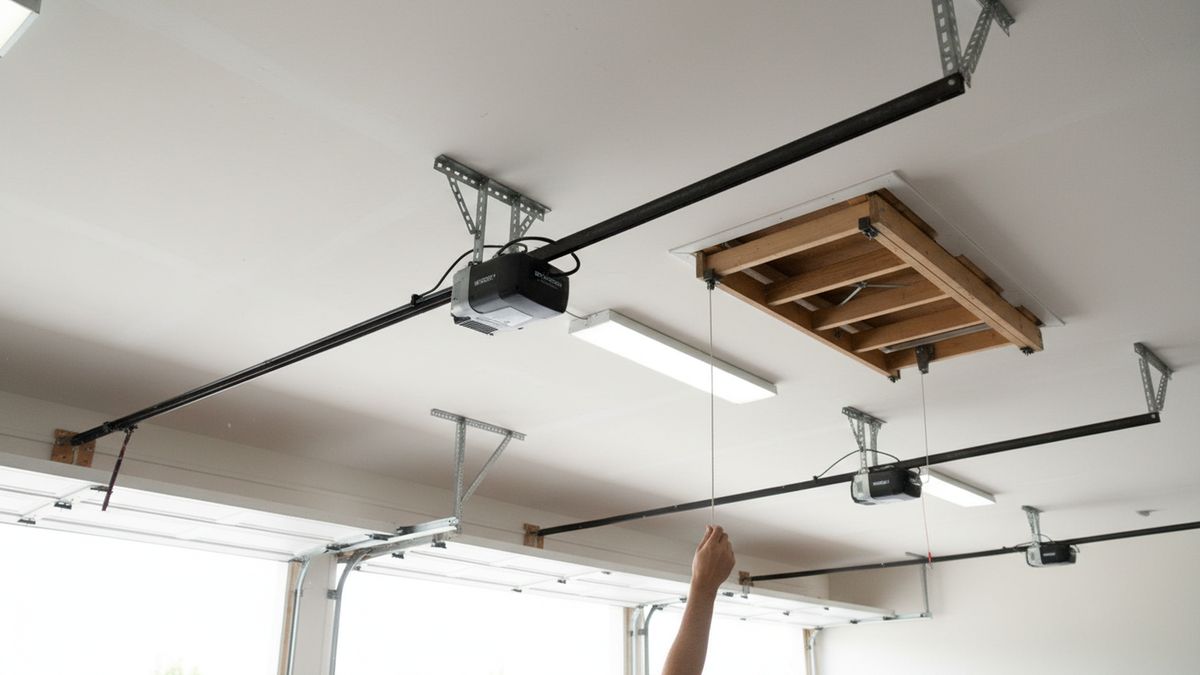
How Do the Three Opener Types Actually Differ?
All 3 do the same job: move a trolley or turn a shaft that lifts a balanced door. A chain drive pulls the trolley along a rail with a bicycle-style steel chain. A belt drive does the same with a steel-reinforced rubber belt. A wall-mount, also called a jackshaft opener, skips the rail and turns the torsion shaft directly.
The difference, in other words, is what connects the motor to the door, and that one choice decides the noise, the price and how much ceiling you keep.
The rail types are what almost every Frisco builder installed between 1999 and today, nearly always a chain drive at the cheaper end. Wall-mount units have been around commercially for decades and moved into homes in the last ten to fifteen years as prices came down.
Screw-drive openers, which turn a long threaded rod, still exist but are rare in new installs. They dislike temperature swings, and a North Texas garage swings 80 degrees between January and August, so we do not recommend them here.
Belt vs Chain vs Wall-Mount: The Comparison Table
Prices are installed ranges for a standard 7-foot residential door in Frisco in 2026, and every one is an estimate until we see the door and the ceiling.
| Chain drive | Belt drive | Wall-mount (jackshaft) | |
|---|---|---|---|
| Noise | Loudest. Metal chain on a metal rail, felt through the framing. | Quiet. Most of what you hear is the door itself. | Quietest. No rail overhead, motor on the wall. |
| Installed price | Lowest, below the belt-drive range | $395 to $700 with Wi-Fi | Several hundred dollars above a belt drive |
| Typical motor | 1/2 HP AC or DC equivalent | 3/4 HP or DC equivalent, battery backup common | DC motor, battery backup common |
| Ceiling space | Rail runs the full door length | Rail runs the full door length | Ceiling stays clear for storage racks or a car lift |
| Door requirements | Any sectional door | Any sectional door | Torsion springs, a few inches of side room, front-mount shaft |
| Wear items | Chain stretch, sprocket, drive gear | Belt, drive gear (rarely) | Cable tension monitor, very few moving parts |
| Best for | Detached garages, single doors, budget replacements | Attached garages, doors under living space | Bedroom over the garage, high or cluttered ceilings, heavy doors |
Horsepower gets more attention than it deserves. A 1/2 HP unit lifts a properly balanced double door with ease, because the springs are doing the heavy lifting. The step up to 3/4 HP or 1-1/4 HP buys a slower-wearing motor and better performance on a heavy insulated or wood door, not the ability to lift a door with a bad spring.
Why a Three-Car Garage Changes the Decision
A three-car garage means two openers, two doors and two different usage patterns, and that is the norm across Frisco. The double door is the daily driver's exit and cycles 4 to 6 times a day. The single bay is often the second car, the mower and the bikes, and might move once a day or once a week.
That split lets you spend where it matters. Put the quiet, higher-spec belt drive on the double door that runs every morning at six, and fit a plain chain drive or a mid-range belt on the single that hardly moves. The second unit does not have to match the first, and mixing brands is fine as long as each is UL 325 compliant with its own photo eyes.
The other three-car factor is layout. Many Frisco plans put the single bay forward of the double, with a bedroom or game room over one or both. A belt drive on a rail still transmits some vibration into the joists it hangs from. A wall-mount transmits almost none, which is why it is the go-to fix when someone upstairs is being woken up at dawn.

When a Wall-Mount Opener Is Worth the Extra Cost
A wall-mount opener earns its premium in three situations, and it is a poor fit in one. The good fits are a bedroom over the garage, a ceiling you want clear for overhead storage or a lift, and a tall or heavy door where a long rail would sag. In each case the jackshaft unit does something a rail opener physically cannot.
The poor fit is a door on extension springs. A jackshaft turns the torsion shaft, so there has to be one. Converting an extension-spring door to torsion is possible and often worthwhile on its own, but it adds to the bill, and our spring conversion and replacement work is priced separately from the opener.
Two more checks before choosing one. The unit needs roughly 8 inches of clear side room next to the shaft on one end, and the door must be balanced well enough to hold itself halfway. A wall-mount will not compensate for a heavy door the way a straining rail opener sometimes appears to.
Whatever opener you pick, it should never be lifting the door. With the door closed, pull the red release cord and raise the door halfway by hand. If it stays put, the springs are right. If it drifts down, the springs need adjustment before a new opener goes in, or the new motor will burn out early. Every new unit, whichever drive, has to meet the federal operator safety rule, so reversal and entrapment protection are not extras you pay for.
What Else to Look For on the Spec Sheet
Drive type is the headline, but four other features decide how much you like the opener five years from now.
- Battery backup. A DC opener with a backup battery runs the door through a storm outage. Batteries last three to five years and are a simple swap.
- Built-in Wi-Fi. LiftMaster and Chamberlain units run on myQ, Genie units on Aladdin Connect. Both need a 2.4 GHz network that reaches the garage, which is a bigger issue in large two-story houses than the box suggests. Our guide to fixing a myQ opener that will not connect covers the pitfalls.
- Rolling-code remotes. Security+ 2.0 on the Chamberlain family, Intellicode on Genie. Both change the code on every press so a captured signal cannot be replayed.
- LED lighting. Older openers used incandescent bulbs that interfered with remote range when the wrong bulb was fitted. Integrated LEDs avoid that and last the life of the unit.
Whichever way you go, the logic board is the part that eventually decides the opener's lifespan in a hot garage, and heat treats every drive type the same. Our article on why opener logic boards fail in Texas garages explains what to expect and how to protect the new unit with a surge protector. If a new install ever refuses to close, Chamberlain's sensor troubleshooting guide is the first thing to check.
Our Recommendation by Bay
For a standard Frisco three-car garage with living space above, we suggest a 3/4 HP belt drive with battery backup on the double door and a 1/2 HP belt or chain on the single. If a bedroom sits over the double door and the door runs on torsion springs, the wall-mount is worth the upgrade.
For a detached or rear-entry garage where noise reaches no one, a chain drive remains a sound, durable choice. It is the opener we still find working after twenty years in the older streets off Eldorado Parkway, and it will take another decade with a gear kit and a new chain.
We install and service all three types across Frisco, from the newer streets around The Star to the west side of the city, and our opener repair and replacement service carries belt and chain units on the van so a swap happens in one visit. If you would rather talk it through, Marlowe Garage Door Service answers the phone around the clock.
Opener Questions From Frisco Three-Car Garages
Is a belt-drive opener really quieter than a chain drive?
Yes, noticeably. The belt runs almost silently along the rail, so most of what you hear is the door's rollers and hinges. A chain drive adds a metallic rattle that carries through the framing into rooms above. On a door with new nylon rollers, a belt drive is quiet enough that people forget it is running.
Do I need a 3/4 HP opener for a double garage door?
Not if the door is balanced. The springs carry the door's weight, and a 1/2 HP unit lifts a balanced 16-foot door without strain. A 3/4 HP or 1-1/4 HP motor makes sense on a heavy insulated or wood door, or if you want a slower-wearing motor on the door you use most, but it will not fix a spring problem.
Can a wall-mount opener go on any garage door?
No. It needs torsion springs on a shaft above the door, a few inches of clear wall space at one end of that shaft, and a door that holds itself when released halfway. Doors on extension springs need a conversion first. Most Frisco doors built after 2000 qualify.
How long does each type of opener last?
Expect 10 to 15 years from a chain or belt drive, and often more from a wall-mount because it has fewer moving parts. In a hot Texas garage the logic board is the part most likely to end an opener's life, regardless of drive type, so a surge protector on the outlet is cheap insurance.
Should both openers in a three-car garage match?
No. Match the opener to how each door is used. A quiet belt drive with battery backup on the double door you use daily, and a simpler unit on the single bay, is the most sensible way to spend the money. The two can even be different brands, each with its own remotes and photo eyes.